

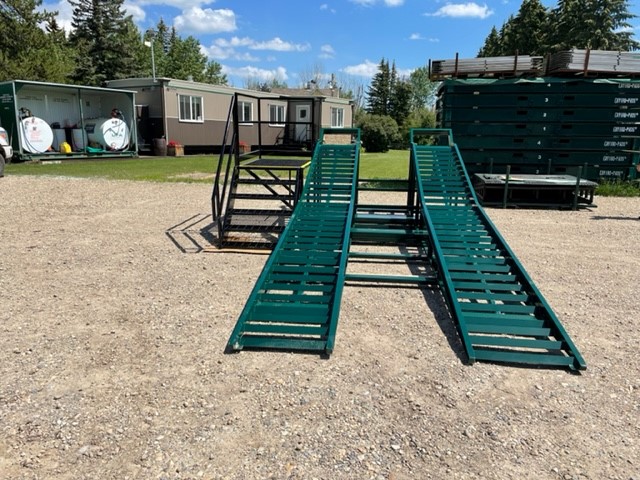
Why would a remote industrial operation deliberately choose a standalone undercarriage wash ramp instead of building the ramp into a full wash-pad containment system? The answer is usually operational fit. A standalone unit can follow mobile work, provide direct access beneath trucks and heavy equipment, and require fewer system components to relocate than an integrated containment setup. Price can matter, but it is not the whole decision.
Remote operations must prioritize exact site-specific fluid management mandates and localized wash-water capture requirements. A standalone ramp may fit one work area, while an integrated ramp and portable wash pad may be more appropriate somewhere else on the same project. Localized surface conditions, stringent wastewater compliance mandates, and expected project duration dictate that choice.
Deploying a standalone undercarriage wash ramp represents a deliberate engineering and operational choice driven by specific application demands.
Standalone setups deliver critical mobility for dynamic operating conditions, while sites demanding strict wash-water capture dictate the deployment of fully integrated containment systems.
Standalone ramps match mobile industrial work
Remote industrial work moves. Work fronts shift, access roads change, and equipment may be reassigned across a mine, pipeline spread, construction project, or plant site. A washing point can quickly become inconvenient when the operation moves away from it.
A standalone undercarriage wash ramp can move with those changing work patterns. Instead of establishing a complete containment area at every point where underside access is needed, operators can evaluate whether the ramp itself can be relocated to the next suitable work area. Mobility was also identified in the supplied client discovery material as an important reason remote sites select standalone configurations.
That flexibility matters when washing needs to follow the equipment. A mining equipment wash ramp may need to serve trucks or heavy equipment in different work areas. Despite that, the ramp does not eliminate site planning, but it keeps underside access from being automatically tied to a larger full-containment footprint.
While exploring specific wash ramps clarifies the available undercarriage access options, the finalized configuration must strictly align with both the deployed equipment and localized site conditions.
They provide direct access to the undercarriage
Undercarriage ramps facilitate critical beneath-vehicle access, streamlining both intensive washing procedures and mandatory maintenance protocols.
Compacted debris and abrasive site materials routinely accumulate beneath the chassis of heavy machinery. Where crews need better access to those areas, a purpose-built ramp can provide working access beneath the equipment that a flat washing surface does not.
Ramp selection must be tailored strictly to the deployed machinery. Because load ratings vary significantly across models, project engineers must validate the equipment’s operational profile against the specific structural capacity of the ramp.
Evaluating specific load capabilities and structural configurations is critical when deploying industrial undercarriage wash ramps for heavy machinery.
Setup and relocation can be simpler
A standalone configuration can make relocation less involved because fewer containment-system components need to move with the ramp. That can be useful when a project expects the washing point to change more than once.
An integrated system can add a containment-pad area, connections, fluid collection capacity, and wash-water management requirements to the configuration. So, moving the washing point may therefore involve more than relocating the ramp itself.
There is no useful universal setup-time promise, especially because ground preparation, access, handling requirements, equipment size, and configuration can all affect deployment.
If mobility is a major project requirement, ask practical questions instead
- How often will the unit move?
- What equipment will be available to handle it?
- Does each proposed location provide an appropriate surface and access route?
Those answers matter more than a generic setup-time figure.
Full containment is a larger infrastructure decision
Adding wash-water containment changes the project from an access-focused setup into a broader washing and fluid-management system.
Depending on the configuration, containment can involve additional pad area, fluid collection or storage capacity, connections, wash-water management planning, and associated equipment. The exact components should be determined for the application rather than assumed from a standard system description.
Teams evaluating integrated containment setups must directly cross-reference their operational demands against the core portable wash pads capabilities and detailed engineering specifications to ensure full compliance.
This decision hinges on long-term infrastructure capabilities and operational readiness rather than baseline capital expenditure. If the site requires wash-water collection and containment, those requirements need to be part of the system. Where those requirements do not apply, operators can evaluate whether the additional containment infrastructure is necessary for the planned washing activity.
Site conditions determine whether standalone is appropriate
A standalone ramp should only be considered where the site’s wash-water plan, environmental controls, surface conditions, contaminants, and operating requirements support that configuration.
Start with the surface and what is being washed off the equipment. Different materials can require different controls, so the wash-water plan needs to reflect the actual site conditions rather than a general assumption about remote or industrial work.
Operations must establish the wash-water compliance mandates dictated by the local regulatory authority.
A remote location does not remove environmental obligations. Nor should an industrial or previously disturbed site be treated as automatic permission to discharge wash water without considering the applicable requirements.
Also, standalone use is not a way to bypass containment obligations.
A standalone truck wash ramp may be workable in one area and unsuitable in another. But where environmental or discharge requirements are unclear, the appropriate site authority or regulator should be consulted rather than relying on a general product rule.
When an integrated containment system should be considered
An integrated containment system should be evaluated when the operation requires a defined area to capture and manage wash water.
That may include sites where wash water must be collected, where project-specific controls require containment, where the material being removed needs controlled handling, or where the surface and surrounding area require additional protection. A defined collection area may also make sense when the site’s washing activity creates an ongoing wash-water management requirement.
An integrated configuration can combine undercarriage access with a portable wash pad so washing and collection occur within one planned system. This may suit operations that need a defined washing point for multiple vehicles or pieces of heavy equipment.
The transition to an integrated containment system depends on evaluating localized environmental compliance standards against the volume of daily washing activity.
Standalone vs integrated: Questions to ask
Before choosing a portable undercarriage wash system, work through the operating conditions rather than starting with a preferred product. Project teams must evaluate the following operational variables to determine the appropriate system architecture:
- Equipment load and dimensions: What trucks, excavators, dozers, tracked equipment, or other machinery will use the ramp? Confirm the appropriate configuration for that equipment.
- Wash purpose: Is the goal underside access, routine cleaning, maintenance support, contamination control, or a combination?
- Wastewater requirements: What does the site require for capturing, storing, pumping out, treating, or removing wash water?
- Site mobility: Will the washing point stay in one location, or does it need to follow changing work fronts?
- Setup frequency: How often will the system be moved, assembled, or reconfigured during the project?
- Surface conditions: What will the ramp sit on, and is that surface appropriate for the equipment and planned washing activity?
- Available footprint and access: Is there enough space for vehicle approach, ramp use, washing activity, and any required containment components?
- Project duration: Is this a short-term or changing project where portability is especially useful, or a recurring wash operation that calls for a more defined station?
If those answers point toward an access requirement with a suitable wash-water plan, a standalone ramp may be the better operational fit. Conversely, operations mandating strict fluid capture and controlled discharge require the immediate evaluation of an integrated system.
Discuss the site before you choose the configuration
For remote industrial operators, the choice between a standalone undercarriage wash ramp and an integrated containment system comes down to what the site needs the equipment to do.
Mobility and direct underside access can make standalone ramps a strong fit for changing work areas. Wash-water requirements, contaminants, surface conditions, and project rules can make containment the more appropriate choice.
Enviro-Pads can discuss your equipment, site mobility, wash-water requirements, available footprint, and project duration before a configuration is selected. Contact us to start a specialized consultation and discuss whether a standalone ramp or integrated containment setup better matches the application.


 THE SOLUTIONS FOR YOUR SOLUTIONS
Primary and Secondary Containment
Made in Canada For All Seasons