

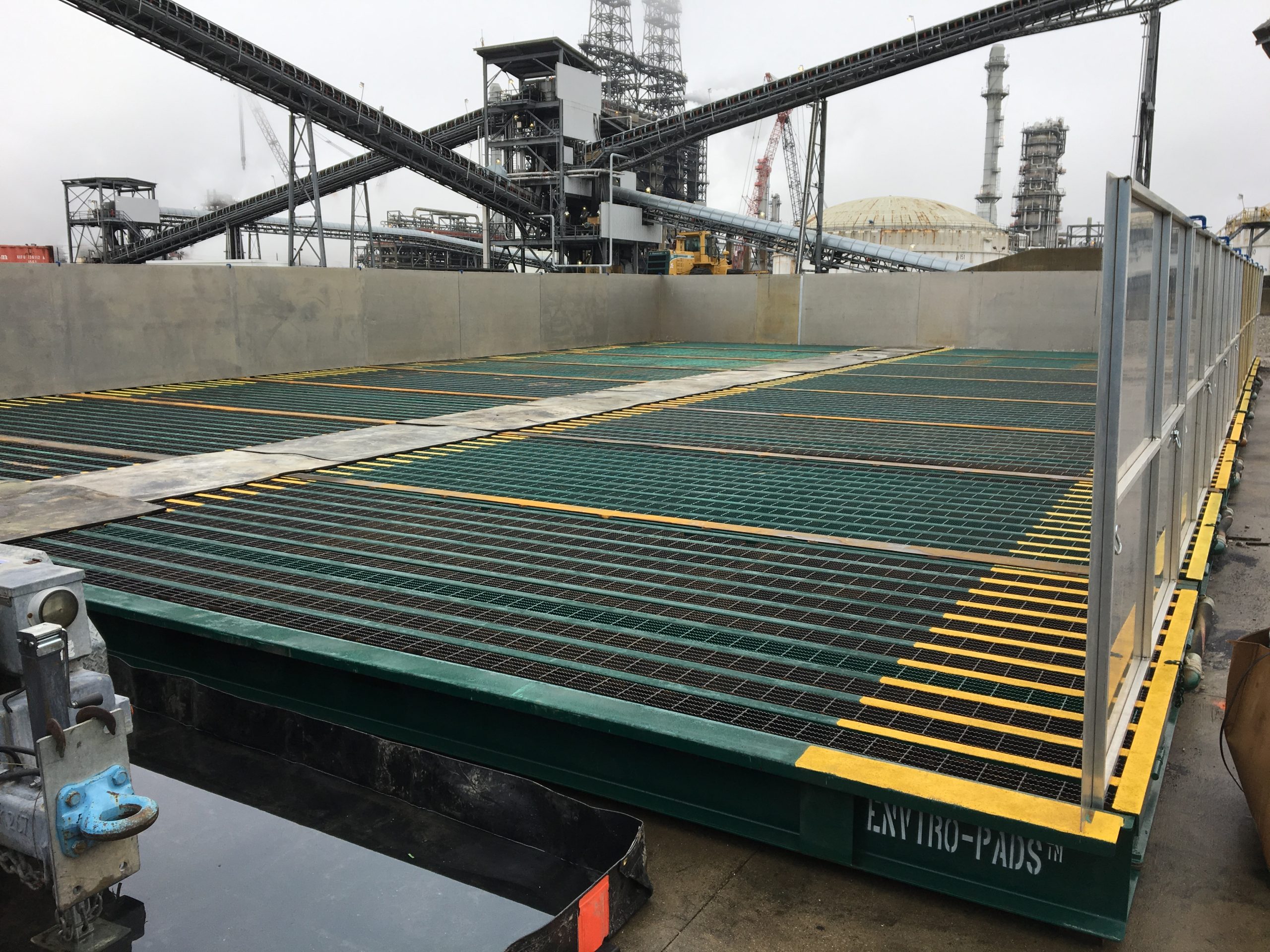
Industrial equipment washing demands a rigorous protocol for wastewater routing and fluid management. For facilities in this sector, the answer needs to cover more than the washing surface. A workable plan considers how wash water is captured, how much the system can hold, how liquid and solids will be removed, and what happens to that material afterward.
A wash pad containment system functions as the foundation of a wash-water workflow by capturing surface water, managing capacity, facilitating solid removal, and ensuring wastewater is handled in accordance with site regulations.
While final project sizing relies on the exact dimensions and capacities detailed within the Enviro-Pads specifications, establishing a clear operating plan remains the critical first step.
What a wash pad containment system is designed to do
A wash pad containment system provides a defined surface for equipment washing while capturing the water and material released during cleaning. Depending on the work, that material can include sediment, mud, grease, hydrocarbons, or other site-specific residues.
The basic system role is straightforward, but the configuration is not universal. Enviro-Pads’ Portable Wash Pads are modular systems engineered to adapt to specific applications. However, successful procurement relies on ensuring the chosen setup perfectly accommodates the equipment, wash methods, and site-specific fluid management protocols.
Full containment is not a universal requirement for every wash application. Certain remote-site operations optimize efficiency by deploying a standalone wash station or ramp instead, a decision dictated by specific site conditions and environmental compliance standards.
Step 1 – Capture wash water at the washing surface
Capture starts by creating a defined washing area that keeps the expected wash water and debris within the planned system. The required footprint depends on more than the vehicle’s parked dimensions.
Equipment size, the direction of spray, drive-on and drive-off movement, hose handling and the working space around the asset all affect the setup. Mitigating overspray requires structural controls like containment walls, while facilitating underside access demands integrated undercarriage components that alter both the system footprint and the overall water flow.
Plan the washing operation and containment area together. Sometimes, a pad that looks large enough can still be awkward if equipment cannot align or crews cannot keep washing inside the collection area.
Step 2 – Plan for water volume and containment capacity
Static pad dimensions alone cannot guarantee adequate volume management. So, accurate capacity planning relies on the functional demands of the active wash station.
Estimate water demand from wash flow, wash duration, wash frequency and the number of units, then consider exposure to rainfall, accumulated solids and how often the system can be emptied.
Use the Enviro-Pads Specifications to compare exact capacities for the configuration under consideration rather than relying on a generic capacity figure.
Step 3 – Move or remove captured water
Once water is captured, the site needs a practical way to remove it before capacity becomes an operating constraint. In this case, the appropriate method depends on the selected configuration and the site plan.
Removal may involve outlet connections, pumping or vacuum access, plus a method for accumulated solids where applicable. The chosen approach should fit site traffic and washing operations.
Step 4 – Decide what happens to the wastewater
Captured wastewater still needs a destination. Storage, treatment, recycling, transport or disposal decisions depend on the contaminants present, the site’s procedures and the requirements that apply in the project jurisdiction.
Project-specific environmental and operating requirements must always take precedence over generalized assumptions. If discharge, treatment or disposal requirements are uncertain, they should be confirmed with the responsible site team and the applicable authority rather than inferred from another project.
When full containment makes sense – and when it may not
Full containment makes sense when the wash-water plan requires water and residue to be captured at the washing point. That may be driven by the contaminants involved, site procedures, nearby receptors, the wash method or other project requirements.
In remote industrial applications, deploying standalone wash stations or undercarriage ramps instead of full containment setups is a strategic configuration choice rather than a bypass of environmental controls. This approach aligns equipment deployment directly with localized site demands and operational scope.
If underside cleaning is part of the job, review the Under Carriage Wash Ramps options as a separate configuration decision. We offer ramp arrangements that can work with containment or as standalone equipment.
Questions to resolve before choosing a system
Before selecting a wash pad containment system, bring the operating variables together. A short checklist can expose gaps before mobilization:
- What is the heaviest and largest equipment that will use the wash area?
- How much wash water is expected from flow rate, duration and wash frequency?
- What contaminants or residues are likely to be present?
- What pad configuration and working footprint are available?
- How will equipment, crews and removal equipment access the area?
- How and how often will captured water and solids be removed?
- How could rainfall, freezing conditions or other weather affect the setup?
- Does the system need to move during the project?
- How long will the wash station be required?
These variables are connected. Operational shifts in equipment scale or fluid volume directly dictate the required system configuration, which is why a specialized review is more useful than selecting a pad by dimensions alone.
Plan the wash-water workflow with Enviro-Pads
Before choosing a configuration, contact Enviro-Pads with the equipment size, site conditions, expected wash-water volume and containment requirements. Our team can review the application and help identify an appropriate portable setup, ensuring the final configuration aligns precisely with the operational realities of the site.


 THE SOLUTIONS FOR YOUR SOLUTIONS
Primary and Secondary Containment
Made in Canada For All Seasons